Thursday, April 12, 2012

“I am grateful for all those dark years, even though in retrospect they seem like a long, bitter prayer that was answered finally.” 
~Marilynne Robinson (Gilead)


Lately I have been having trouble forming words, and not feeling much like forcing them, I will just say: my life is turning into something I never imagined. I am surrounded by friendship and love, and despite tragedy and loss that has come with growing and settling down, I feel drawn to a different narrative, still wondering at times if I am glimpsing the edge of a Creator. I have loved this blog, but I think it may be time to take my poetry somewhere else. Of course you will hear more about that when the time comes. For now here is a song. 


Thursday, March 15, 2012

(To crave what the light does crave)

to crave what the light does crave
to shelter, to flee
to gain desire of every splayed leaf
to calm cattle, to heat the mare
to coax dead flies back from slumber
to turn the gaze of each opened bud
to ripe the fruit to rot the fruit
and drive down under the earth
to lord a gentle dust
to lend a glancing grace to llamas
to gather dampness from fields
and divide birds
and divde the ewes from slaughter
and raise the corn and bend the wheat
and drive tractors to ruin
burnish the fox, brother the hawk
shed the snake, bloom the weed
and drive all wind diurnal
to blanch the fire and clot the cloud
to husk, to harvest,
sheave and chaff
to choose the bird
and voice the bird
to sing us, veery, into darkness

Kevin Goodan


Tuesday, March 13, 2012

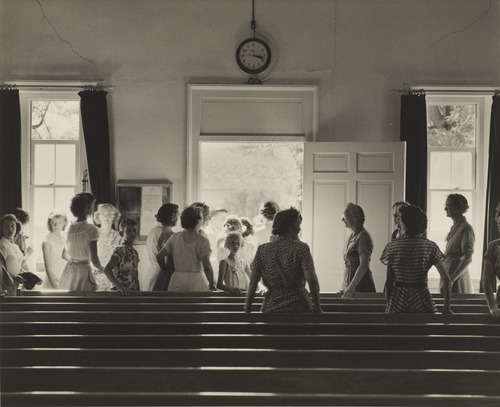
"Leaving Church," Toquerville, UT 1953

In a photo project entitled "Three Mormon Towns," Dorothea Lange partnered with Amsel Adams to photograph three communities in Southern Utah during a time of postwar change: Gunlock, Toquerville, and St. George. The photos appeared in LIFE magazine, to the surprise of the subjects, which of course created no small stir. Amsel Adams apparently had wanted to inform the subjects of their intentions to publish, but that is not what I really want to talk about here.  I feel so much when I look at this picture. Memories of Southern Utah with my grandparents come to mind. Sunday after Sunday comes to mind. The Mormon people come to mind, always with the deep connection to the American West. And I remember where I came from, I always remember where I came from, though I have gone far.


Roots Cannot Be Torn From Under

I did not
slam the door, or even
shout

there was no
standing on a pulpit
or crashing of plates
like maybe

some would say
there should have
been

when they blessed the
bread, I listened
to the blessing of souls about
to partake

in remembrance of the Son
for the Spirit to be with them.

The cups passed in front of me
I passed the shining 
silver tray in front of me.

My head was bowed
my eyes were raised
it was the last time

it was the last time

I would sit
under the
invisible
pounding
soon to be 
lifting
weight

Monday, February 20, 2012


Some sentences, from Marilynne Robinson, in Housekeeping: 

(Sylvie) glanced up sometimes at the snow, which was the color of heavy clouds, and the sky, which was the color of melting snow, and all the slick black planks and sticks and stumps that erupted as the snow sank away.

The water was so calm that the sunken half of the fallen tree was replaced by the mirrored image of the half trunk and limbs that remained above the water.

"Look at this," Sylvie said, spreading the paper in her lap. "There's an article here about a woman in Oklahoma who lost an arm in an aircraft factory, but who still manages to support six children by giving piano lessons." Silvie's interest in this article struck me as generous.

For need can blossom into all the compensations it requires. To crave and to have are a like as a thing and its shadow...and when do our senses know anything so utterly as when we lack it? And here again is a foreshadowing--the world will be made whole....So whatever we may lose, very craving gives it back to us again.

Lot's wife was salt and barren, because she was full of loss and mourning, and looked back. But here rare flowers would gleam in her hair, and on her breast, and in her hands, and there would be children all around her, to love and marvel at her for her beauty, and to laugh at her extravagant adornments, as if they had set the flowers in her hair and thrown down all the flowers at her feet, and they would forgiver her, eagerly, lavishly, for turning away, though she never asked to be forgiven.


Friday, January 13, 2012


Everyday I spend with women in shelter I am awestruck by how much courage there is to be gathered in the face of violence, whether it is sexual, physical, or verbal. It is a very fragile moment, when I look a woman in the eye and ask her if she has been sexually assaulted. I want to be as present as I can possibly be in that moment.  And while the sense of powerlessness and betrayal quivers in her voice, I wait for her to speak.  

In New York, a new organization has opened a shelter specifically to serve foreign born victims of sex-trafficking.  One shelter in the entire city, in the entire region for that matter. Whether through literal prostitution or pornography production, the buying and selling of sex requires bodies to be viewed as commodities.  And the trauma and dehumanization is not less than profound in the midst of a massive demand and a violent silence. I am speaking most angrily about children and minors here, though I would argue that many if not most adults selling their bodies do not understand what a choice is. We live during a time when isolated bedrooms are being used as viral colosseums, where gladiators are young girls and boys,  and the tickets holders will let you watch from your own private room. Everyday young women are told they have no where else to go, that no one will believe them.  Let us learn how to recognize the signs, the invisible lives that are right before us. There are millions of slaves passing through our borders, and their oppressors walk freely on our soil. It is a problem that goes beyond a few horrifying stories, it is systematic, epidemic, and it is time to educate ourselves on what can be done. 

Friday, January 6, 2012

The time has come, the walrus said, to talk of many things.
~Lewis Carroll


Recently I took a stroll through the woods on Anastasia Island,
it is often said there are no seasons in Florida
but I beg to differ,
the trees here are as lively and as changing
as any I have seen
while there are more thumps and scurries
and rustling noises between the leaves.
On this walk as the sun began to fade and
I reluctantly left the woods, 
you will see what happened in the sky.
And I am home here, even if not entirely sure why.


From a Season of Doubt

It was late August.
I wasn't thinking of
how a flock of birds
flying west

might search for a canopy
on a yellow, treeless plain
or how their wings might
tip and sway as the granite
patriarchs began to
rise into the sky

Not even
could I imagine
their solace, the trembling
laughter of applause
tingling through the
evergreen trees

when they finally reached
their boughs in the place
I could no longer weep.

It was the birds who knew
how to travel and soar
and equally how to
 nest and stay
how to let the sun touch
down on their warm and
weary wings

And even though
I did not hear them sing
 there were birds everywhere

Monday, December 5, 2011

The Anguished Seriousness of Advent, Thomas Merton


Three years ago this week I drove around a roundabout on Main Street in Concord Massachusetts where I taught preschool, snowbanks full, candles glowing through dark windows, a wooden Nativity scene.  Concord is an intellectual town not particularly concerned with religiosity other than for the sake of tradition, and so the sight of Christian celebration was very striking. But I reacted with an involuntary cringe that was evidence of my ambivalence for religious yearning at the time, at least within the walls of a church.
Today I had planned to begin a new blog tradition, "Mary Oliver Monday."  I went to the store to buy a book for my nephew, whom I will miss so much this Christmas while staying in Florida. I came home with a few bags of materials for gift making, did some laundry, and spent the evening decorating ornaments with the ladies of the church I am now attending. Throughout the day, a growing sense of emptiness began to knot into a sorrow which did not allow me to concentrate on anything I tried to do. The dark silhouettes outlining the evergreen trees in Washington had been present in my mind all day, as though I would be going home.  And every year I am stricken by the darkness that hits so early in the afternoon this time of year, even if I grew up with it. Just an hour under the fluorescent overload of commercialized Christmas today was enough to drive me back to the same hunger I have so often felt since that anguished New England season, a slow hope bringing me home. Thomas Merton may have been on to something when he said that "advertising treats all products with the reverence and the seriousness due to sacraments." More than any other writer I know he talks about finding hope in Christ in deep darkness. And so, for Monday, here is Thomas Merton on Advent:
"It is important to remember the deep, in some ways anguished seriousness of Advent, when the mendacious celebrations of our marketing culture so easily harmonize with our tendency to regard Christmas, consciously or otherwise, as a return to our own innocence and our own infancy. Advent should remind us that the “King Who is to Come” is more than a charming infant smiling (or if you prefer a dolorous spirituality, weeping) in the straw. There is certainly nothing wrong with the traditional family joys of Christmas, nor need we be ashamed to find ourselves still able to anticipate them without too much ambivalence. After all, that in itself is no mean feat.
But the Church in preparing us for the birth of a “great prophet,” a Savior and a King of Peace, has more in mind than seasonal cheer. The Advent mystery focuses the light of faith upon the very meaning of life, of history, of man, of the world and of our own being. In Advent we celebrate the coming and indeed the presence of Christ in our world. We witness to His presence even in the midst of all its inscrutable problems and tragedies. Our Advent faith is not an escape from the world to a misty realm of slogans and comforts which declare our problems to be unreal, our tragedies inexistent."