(Like gallons of water pumping from aquifers into springs, for instance)
"Who can be stillness, little by little
make what is troubled grow clear?
Who can be movement, little by little
make what is still grow quick?"
~Tao Te Ching
Saturday, August 31, 2013


Tuesday, February 26, 2013
One True Poem
Doug Ramspeck
The deer this time of year are gray. I see them
near the railroad tracks. What I like about them
is how they flee at the first sign they are observed.
But the one today is full-sized, on its side in the bar
ditch, with a white belly, its neck bent, smudges
of red in the snow like dropped handkerchiefs.
I have been thinking about how often my students
arrive at my office to show me poems they have written.
How often they tell the background story, how they
dressed up experience in the skin of a dead deer,
how they splayed themselves in a bar ditch for everyone
to see. Occasionally they weep, wiping their noses
with their fingers, their insides spilling raw at
the roadside, their necks lolling. Sometimes a single
salty drop falls to the handwritten page and stains it,
leaving a blue ink splotch, as though all sorrow
is a smudge. They want to be that poor deer
where the snow is coming down, dropping out
of the sky, making of the body a mound to be buried
in white, the smooth belly the same white as the snow,
as though a deer might enter the landscape, become
the landscape. To be that one true poem, the one
where you bleed a little on the snow. But tomorrow
I will remind my students that there is a weak sun
in this January sky, an old woman with b.o. they stood
behind once while taking the Sacrament, these Ohio
factories with their broken windows and the grass
in summer spilling through the cracks in the cement.
Please, I will say, there is more to write about than dying
grandmothers, a boyfriend who left you, a winning shot
in the state finals, a first sexual experience, an alcoholic
father who made your mother jump once from
a rowboat into Grand Lake St. Mary’s because she’d
forgotten the buns for the hotdogs. Just once let
your poems run wild into the night, like deer rushing
across the road, to feel the aloneness of the body, the way
the legs move and carry us. One last true poem, the one
where the deer is forever by the roadside, the cars
speeding past, how cold and hard the ground feels,
the snow covering us until the rains arrive come spring
and the body transforms gradually to mud. Together,
I will tell them, we will lift that deer from the bar ditch
and tumble it over the edge into the river, like in that
Stafford poem I assigned last week, though my
students all asked the same thing, over and over,
the same thing they always ask: is the story true?
near the railroad tracks. What I like about them
is how they flee at the first sign they are observed.
But the one today is full-sized, on its side in the bar
ditch, with a white belly, its neck bent, smudges
of red in the snow like dropped handkerchiefs.
I have been thinking about how often my students
arrive at my office to show me poems they have written.
How often they tell the background story, how they
dressed up experience in the skin of a dead deer,
how they splayed themselves in a bar ditch for everyone
to see. Occasionally they weep, wiping their noses
with their fingers, their insides spilling raw at
the roadside, their necks lolling. Sometimes a single
salty drop falls to the handwritten page and stains it,
leaving a blue ink splotch, as though all sorrow
is a smudge. They want to be that poor deer
where the snow is coming down, dropping out
of the sky, making of the body a mound to be buried
in white, the smooth belly the same white as the snow,
as though a deer might enter the landscape, become
the landscape. To be that one true poem, the one
where you bleed a little on the snow. But tomorrow
I will remind my students that there is a weak sun
in this January sky, an old woman with b.o. they stood
behind once while taking the Sacrament, these Ohio
factories with their broken windows and the grass
in summer spilling through the cracks in the cement.
Please, I will say, there is more to write about than dying
grandmothers, a boyfriend who left you, a winning shot
in the state finals, a first sexual experience, an alcoholic
father who made your mother jump once from
a rowboat into Grand Lake St. Mary’s because she’d
forgotten the buns for the hotdogs. Just once let
your poems run wild into the night, like deer rushing
across the road, to feel the aloneness of the body, the way
the legs move and carry us. One last true poem, the one
where the deer is forever by the roadside, the cars
speeding past, how cold and hard the ground feels,
the snow covering us until the rains arrive come spring
and the body transforms gradually to mud. Together,
I will tell them, we will lift that deer from the bar ditch
and tumble it over the edge into the river, like in that
Stafford poem I assigned last week, though my
students all asked the same thing, over and over,
the same thing they always ask: is the story true?
Thursday, October 4, 2012
At the End of Her Wandering
white petals lay before her
feet, a breeze
soft, silent,
quakes like aspens
quivers like maple
floats like reeds-
water oaks hold out their arms, hover
as a mother would, hold her elbows
as a father
would
as if to say-
"Come child,
you were always meant
to be received." (her lover sees her)
and she is unafraid
of what his gaze can
do, for already her
orphaned feet like exiled
sheep, have begun to shed
their calloused wounds
feet, a breeze
soft, silent,
quakes like aspens
quivers like maple
floats like reeds-
water oaks hold out their arms, hover
as a mother would, hold her elbows
as a father
would
as if to say-
"Come child,
you were always meant
to be received." (her lover sees her)
and she is unafraid
of what his gaze can
do, for already her
orphaned feet like exiled
sheep, have begun to shed
their calloused wounds
Monday, September 10, 2012
At sunset, on the eve of fall
An opening -
yarrow, juniper, tiny spiders
with fire on their winged
bellies, the pines
here, in the
flattest of landscapes
and I held my Uncle's hand
we watched the temple glow
the cold wind pushed
through the yellow grass below
flat and silent
the way it was goodbye
yarrow, juniper, tiny spiders
with fire on their winged
bellies, the pines
in Florida never cease to make
me look higher
than my current hope
me look higher
than my current hope
for the ones I love
to reach beyond
to reach beyond
their prickled wounds
Every step further-
my acquaintance
with once foreign sounds
grows familiar
palm fronds swing,
with once foreign sounds
grows familiar
palm fronds swing,
fiddlers creak in and out
of their holes, unseen
insects tease--
of their holes, unseen
insects tease--
like always,
I walk to the edge
of where my feet can go
and as the sun stretches
down over the marsh,
old wounds grow faint
and I remember it all
I walk to the edge
of where my feet can go
and as the sun stretches
down over the marsh,
old wounds grow faint
and I remember it all
here, in the
flattest of landscapes
the purple rising
behind every crevice
of the Wasatch mountains
the golden streams
which once struck
into a darkening sky
behind every crevice
of the Wasatch mountains
the golden streams
which once struck
into a darkening sky
and I held my Uncle's hand
we watched the temple glow
the cold wind pushed
through the yellow grass below
flat and silent
the way it was goodbye
Thursday, April 12, 2012
“I am grateful for all those dark years, even though in retrospect they seem like a long, bitter prayer that was answered finally.”
~Marilynne Robinson (Gilead)
~Marilynne Robinson (Gilead)
Lately I have been having trouble forming words, and not feeling much like forcing them, I will just say: my life is turning into something I never imagined. I am surrounded by friendship and love, and despite tragedy and loss that has come with growing and settling down, I feel drawn to a different narrative, still wondering at times if I am glimpsing the edge of a Creator. I have loved this blog, but I think it may be time to take my poetry somewhere else. Of course you will hear more about that when the time comes. For now here is a song.
Thursday, March 15, 2012
(To crave what the light does crave)
to crave what the light does crave
to shelter, to flee
to gain desire of every splayed leaf
to calm cattle, to heat the mare
to coax dead flies back from slumber
to turn the gaze of each opened bud
to ripe the fruit to rot the fruit
and drive down under the earth
to lord a gentle dust
to lend a glancing grace to llamas
to gather dampness from fields
and divide birds
and divde the ewes from slaughter
and raise the corn and bend the wheat
and drive tractors to ruin
burnish the fox, brother the hawk
shed the snake, bloom the weed
and drive all wind diurnal
to blanch the fire and clot the cloud
to husk, to harvest,
sheave and chaff
to choose the bird
and voice the bird
to sing us, veery, into darkness
Kevin Goodan
to shelter, to flee
to gain desire of every splayed leaf
to calm cattle, to heat the mare
to coax dead flies back from slumber
to turn the gaze of each opened bud
to ripe the fruit to rot the fruit
and drive down under the earth
to lord a gentle dust
to lend a glancing grace to llamas
to gather dampness from fields
and divide birds
and divde the ewes from slaughter
and raise the corn and bend the wheat
and drive tractors to ruin
burnish the fox, brother the hawk
shed the snake, bloom the weed
and drive all wind diurnal
to blanch the fire and clot the cloud
to husk, to harvest,
sheave and chaff
to choose the bird
and voice the bird
to sing us, veery, into darkness
Kevin Goodan
Tuesday, March 13, 2012
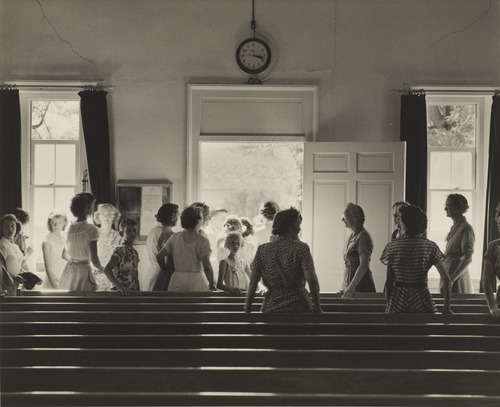
"Leaving Church," Toquerville, UT 1953
In a photo project entitled "Three Mormon Towns," Dorothea Lange partnered with Amsel Adams to photograph three communities in Southern Utah during a time of postwar change: Gunlock, Toquerville, and St. George. The photos appeared in LIFE magazine, to the surprise of the subjects, which of course created no small stir. Amsel Adams apparently had wanted to inform the subjects of their intentions to publish, but that is not what I really want to talk about here. I feel so much when I look at this picture. Memories of Southern Utah with my grandparents come to mind. Sunday after Sunday comes to mind. The Mormon people come to mind, always with the deep connection to the American West. And I remember where I came from, I always remember where I came from, though I have gone far.
Roots Cannot Be Torn From Under
I did not
slam the door, or even
shout
there was no
standing on a pulpit
or crashing of plates
like maybe
some would say
there should have
been
when they blessed the
bread, I listened
to the blessing of souls about
to partake
in remembrance of the Son
for the Spirit to be with them.
The cups passed in front of me
I passed the shining
silver tray in front of me.
My head was bowed
my eyes were raised
it was the last time
it was the last time
silver tray in front of me.
My head was bowed
my eyes were raised
it was the last time
it was the last time
I would sit
under the
invisible
pounding
soon to be
lifting
weight
under the
invisible
pounding
soon to be
lifting
weight
Subscribe to:
Posts (Atom)